
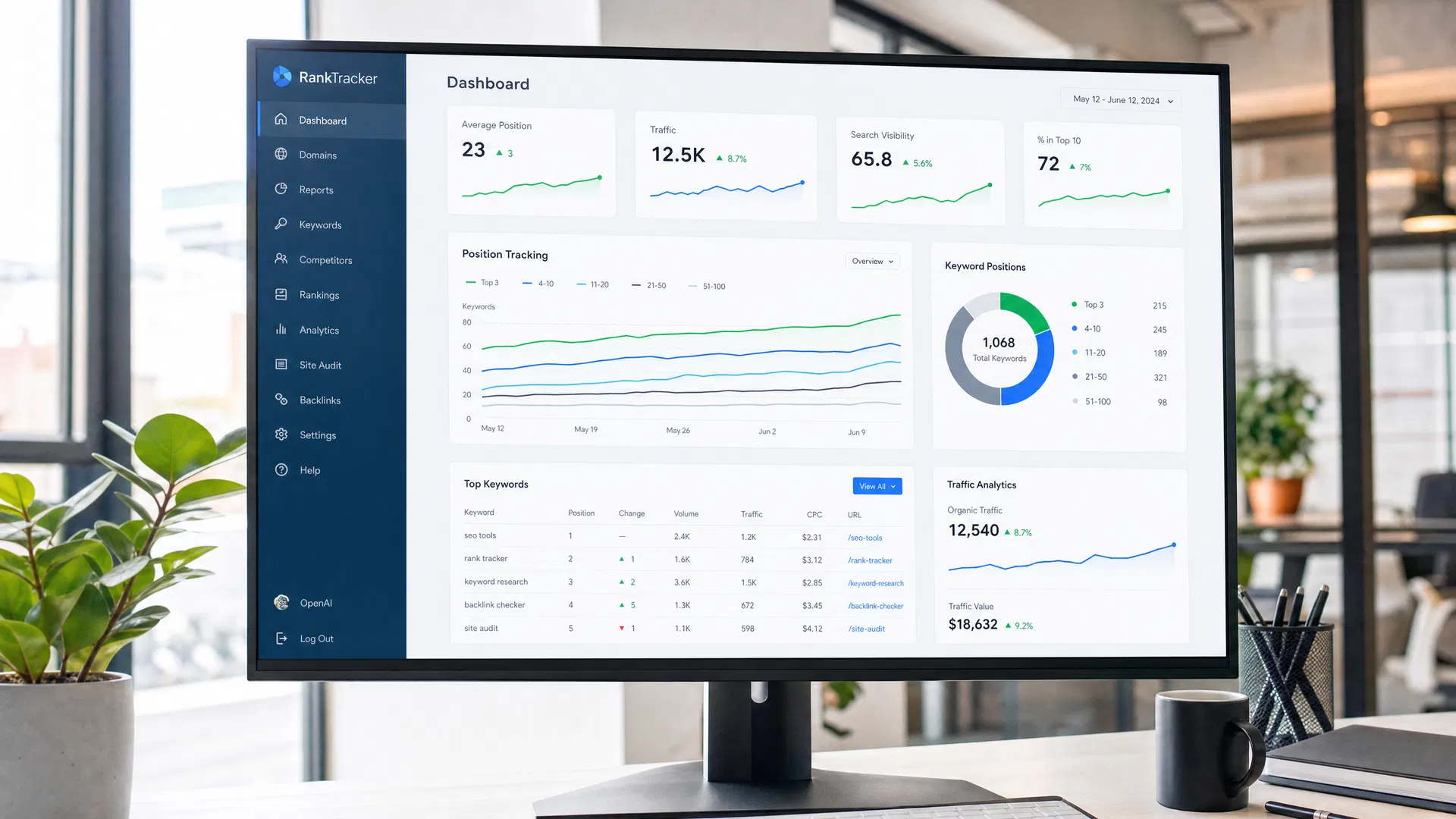
In 2026, SEO doesn't lend itself to sporadic efforts or monthly analyses alone. Search engine algorithms keep changing and rely more and more on artificial intelligence to refine their results. For agencies, consultants and web professionals, the question is no longer whether to monitor rankings, but how often and at what level of detail. For the keywords that matter, daily tracking gives you a responsiveness that a weekly check can't match.
Why can weekly or monthly tracking let problems slip through? Because search engine results pages (SERPs) move often. A drop on a strategic keyword can cost traffic, leads and revenue during the days when nobody notices it. With daily rank tracking, you spot these movements at the next check, better understand shifting search intent and react before your competitors do.
This article explains what daily SEO rank tracking brings, and where its limits lie. We'll look at the current dynamics of search engines, the concrete benefits of close monitoring and how to build it into your strategy without drowning in ordinary fluctuations.
SERPs that move often in 2026
Search engines have undergone radical transformations in recent years. Integrating generative AI directly into search results has upended the way users interact with information. This shift makes traditional rankings more fluid, and hard-won positions less stable than before.
The impact of AI and continuous updates
Google changes its algorithm constantly, and most of these changes are not announced. On top of that come several major updates a year, the "Core Updates," which Google announces on its Search Status Dashboard and which roll out over several days or weeks. These changes can tip a page's ranking in a short time. Close tracking helps you spot these variations early, before they turn into lasting trends.
Key takeaway: rankings for commercial queries move often, sometimes from one day to the next. Without tracking, you discover a drop in your traffic statistics, often weeks later.
With an SEO platform that checks your rankings every day, you can match these movements with Google updates and adjust your strategy accordingly. This lets you tell an ordinary fluctuation, which settles on its own, apart from a manual action or a loss of relevance of your content in the face of new algorithmic expectations.
Location and device
Search results vary by device and, above all, by the user's location. A national ranking means little for a local business or a franchise. Well-configured tracking lets you analyze performance by country or city and by device (mobile or desktop), a level of detail that targeted campaigns need.
To make sure your site meets the technical requirements of this advanced personalization, a regular technical SEO audit is strongly recommended. It checks that your site handles hreflang tags correctly if you operate internationally and delivers a good user experience (UX): page experience is one of the signals Google takes into account.
The evolution of search intent
Search intent isn't static. A keyword that had purely informational intent six months ago can suddenly shift to transactional intent because of a market trend or a news event. Daily tracking helps you spot these semantic shifts. If you notice that the pages outranking you offer a different format (for example, a video or an interactive tool rather than a long article), it's a sign that it's time to rework your content.
Detecting opportunities and threats early
One of the advantages of daily tracking is the ability to act early rather than suffer the consequences. When every click counts, reacting a few days sooner makes a difference.
Identifying and fixing sudden drops
A sudden drop of several positions on a strategic keyword with high search volume and a high conversion rate can weigh heavily on your revenue. If you only check your rankings once a week, you risk losing several days of qualified traffic to your competitors. A tracking tool can alert you at the next check, so you can look for the cause right away.
- Unexpected technical issues: A 404 error after a poorly managed migration, a sudden slowdown in load time due to a failing server, or an indexing problem caused by an accidental noindex tag can be identified and fixed quickly.
- Negative SEO attacks: They are rare, and Google says it ignores most spam links. Regular backlink analysis still helps you spot an abnormal influx of toxic links and, if needed, prepare a disavow file.
- Keyword cannibalization: A change in the ranking URL quickly shows that a new page on your blog is competing with an existing pillar page for the same query, at the risk of diluting your topical authority.
Capitalizing on quick gains and emerging trends
Conversely, daily tracking helps you identify pages that are suddenly gaining traction. If an article starts climbing the SERPs for an unexpected or long-tail query, you can optimize that page right away to consolidate the position.
Key takeaway: keywords ranking just past the first page (between 11th and 15th place, for example) are often the easiest to move up, with targeted optimizations (internal linking, richer content).
This is where AI content optimization comes into its own. By comparing your content with the top-ranking pages, you can enrich your text, add relevant named entities and better meet users' expectations, which helps the page move up.
Optimizing your content and link building strategy
Rank tracking isn't an end in itself; it is a diagnostic tool that should guide your optimization work. Fresh data quickly shows you the effect of your SEO efforts, so you can work in iterations.
Measuring the immediate impact of your actions
When you publish a new in-depth article, change a title tag to improve CTR (click-through rate) or launch a link building campaign, you want to know whether it's working. Daily tracking lets you see the first movements in the SERPs a few days after the page is crawled again.
To get an overview of your site's health before making major changes, it is crucial to carry out a full SEO audit. This establishes a solid baseline from which you can measure your daily progress and calculate the ROI of your optimization work.
Dynamically adjusting your editorial calendar
Search trends change quickly, influenced by the news, seasonality or new consumer behavior. By monitoring a broad panel of keywords every day, including those targeted by your direct competitors, you can identify new content opportunities before they become saturated. This lets you adapt your editorial calendar quickly and capture qualified traffic in the discovery phase.
Steering your link building campaigns with precision
Acquiring backlinks remains a fundamental pillar of SEO in 2026. However, the impact of a new link can vary considerably. By tracking your rankings daily, you can assess the real effectiveness of the links you earn. If a page gains positions shortly after acquiring a quality backlink, that's a sign your strategy is working, to be confirmed over time. Conversely, if no movement is observed after several weeks, you may need to rethink the quality of the referring domains or the optimization of your anchor texts.
The role of professional tools
You can't track hundreds or thousands of keywords by hand every day across different devices and locations. A professional tool quickly becomes necessary for any agency or business that wants to measure the return on its SEO investment.
Automation, accuracy and reliable data
Tracking platforms automate the collection of rankings. Unlike a manual check, skewed by your browser history and your location, they read the results page from the location and device you choose, the same way at every check.
In Zerkado, the automatic frequency checks keywords ranking in the top 10 every day, and those ranking further down every 2 to 5 days: tracking is daily where a change costs the most. After each check, an email lists the keywords that went up, went down, entered or left the rankings. Discover all our features, from rank tracking to competitive analysis.
Clear reports for transparent communication
For SEO agencies and independent consultants, the ability to demonstrate the value of their work to clients is paramount. Frequent data makes it possible to generate detailed, readable SEO reports that show progress, justify investments and explain ordinary ranking fluctuations.
Key takeaway: in an agency, transparency helps retain clients. Reports based on up-to-date data, with an expert's commentary, strengthen their trust.
Comparison: Daily Tracking vs. Weekly Tracking
To see what's at stake, here is a table comparing daily monitoring with a weekly check of your rankings. Daily tracking has a cost too: more ordinary fluctuations to sort through.
| Evaluation criterion | Daily Tracking (Proactive) | Weekly Tracking (Reactive) |
|---|---|---|
| Responsiveness to traffic drops | Fast (drop visible at the next check) | Slow (up to 7 days of lost traffic and revenue) |
| Detection of Google updates | Date of the movement known to the day | Hard to correlate precisely, smoothed data |
| Analysis of SERP volatility | Good, detailed view (to be read over several checks) | Weak, data smoothing hides micro-movements |
| Content optimization (on-page) | Agile, fast and measurable adjustments | Delayed revisions, short-term opportunities lost |
| Competitive advantage in the market | Faster reaction to competitors' moves | Reactive, often behind emerging trends |
| Crisis management (e.g., hacking) | Detection at the next check | Risk of prolonged deindexing before detection |
If you're still unsure which solution to adopt for your agency or your in-house projects, see our comparison, which positions Zerkado against the main tools on the market (public entry prices and features).
Building daily tracking into your work routine
Adopting daily tracking doesn't mean spending hours every morning staring at stressful charts. It's about setting up smooth processes and smart systems that work for you in the background.
Alerts that filter out the noise
Daily tracking stays effective as long as it doesn't force you to look at everything. Depending on the tool, alert thresholds are adjustable or fixed. In Zerkado they are fixed, chosen to filter out the noise: an alert flags a keyword that drops out of the top 10 or falls sharply on page one or two, while the email sent after each check lists every change.
Cross-analyzing data for a holistic view
Never look at your rankings in isolation. A ranking is just a vanity metric if it doesn't generate value. Cross-reference this ranking data with your actual organic traffic (via Google Analytics or Matomo), your conversions (leads, sales) and your crawl data (via Google Search Console). This holistic approach will help you understand the real impact of your rankings on your ultimate business goals.
Running team meetings based on fresh data
For marketing teams, having daily data makes for much more relevant meetings (stand-ups). Instead of discussing assumptions, the team can focus on the actual movements observed the day before: "We lost 2 places on query X; can the tech team check the server response time? Can the content team analyze the competitor's new page that overtook us?" Keep one simple rule: a one-day change is something to watch; a drop that lasts over several checks is something to fix.
Conclusion: well-configured daily tracking
In 2026, daily SEO rank tracking is no longer reserved for multinationals or large e-commerce sites. For your strategic keywords, it helps you protect and grow your visibility. SERPs move often, generative AI is changing the shape of the results and competition remains strong in most industries.
With this approach, you're not just protecting your existing traffic: you spot opportunities sooner, focus your resources where they count and measure the effect of each action. Read over several checks, daily data guides your decisions instead of alarming you at every fluctuation.
To track your rankings with Zerkado, check our pricing: plans range from independent consultants to agencies, and the 14-day free trial, with no credit card required, lets you test tracking on your own keywords.