
In e-commerce, which is highly competitive in 2026, great products aren't enough to bring in customers. Search engine optimization (SEO) is one of the most durable acquisition channels for online retailers: a well-ranked page keeps attracting visitors with no cost per click. A well-designed e-commerce SEO strategy brings in qualified traffic and reduces your dependence on paid advertising.
However, ecommerce SEO comes with unique challenges. Unlike a standard brochure site, an online store has to manage thousands of pages, duplicate content issues, complex faceted filters and product pages that change constantly as stock levels move. To navigate this complexity, you need a methodical approach that combines technical excellence, semantic relevance and domain authority.
In this guide, we cover the pillars of an e-commerce SEO strategy: architecture, technical SEO, faceted navigation, keywords, product and category pages, Product structured data, link building, internal linking and measuring results. Whether you run a small niche store or a catalog of tens of thousands of products, these practices will help you gain visibility and turn visitors into customers.
The Foundations of a Successful Ecommerce SEO Strategy
Before trying to optimize specific keywords or earn links, make sure the foundations of your e-commerce site are solid. A poorly structured or technically flawed site will struggle to rank over time, even with good content.
Why site architecture matters
Your ecommerce site architecture, meaning the way your pages are organized and linked to one another, plays a fundamental role in your SEO success. A good architecture lets Google's crawlers easily discover and index all of your important pages. It also helps users quickly find what they're looking for, which improves the user experience (UX) and, in turn, your conversion rates.
A commonly cited benchmark is the three-click rule: an important product should be reachable in just a few clicks from the home page. It isn't a Google rule, but it is good practice: the deeper a page sits, the fewer internal links it receives and the more likely it is to be crawled rarely. To get there, group your products into logical categories and subcategories, following a silo structure. This topical organization also helps search engines understand your pages.
A clear, logical site architecture is the skeleton of your SEO strategy. Without it, your content creation and link building efforts can collapse like a house of cards. Always think about the user first: if navigation is intuitive for them, it will be intuitive for Google too.
Technical optimization: an essential prerequisite
Technical SEO is often the Achilles' heel of ecommerce sites. Slow load times, duplicate content (often caused by parameterized URLs from search filters) and poor crawl budget management can wreck your SEO efforts. That's why you need to run a thorough Technical SEO Audit on a regular basis to identify and fix these bottlenecks.
The technical elements to watch closely include:
- Page speed: Core Web Vitals are among the page experience signals Google takes into account. They don't replace relevance, but a slow site drives customers away. Aim for Google's thresholds: LCP under 2.5 s, INP under 200 ms, CLS under 0.1.
- Responsive design: A large share of online purchases happens on mobile, so your site must deliver a flawless experience on smartphones.
- Facet management: Filters (size, color, price) can create thousands of near-identical URLs. Decide which combinations deserve to be indexed, for example "red dress", and handle the rest: a canonical tag pointing to the category, a noindex tag, or blocking crawling in robots.txt to preserve crawl budget. Be careful: Google doesn't read a URL blocked by robots.txt, so it sees neither its canonical nor its noindex, and the URL can stay indexed if it receives links.
- Security: HTTPS is mandatory, all the more so on an ecommerce site that handles payment data.
Keyword Research and Purchase Intent
Keyword research is the starting point of any content strategy. For an ecommerce site, the goal isn't just to generate traffic but to attract visitors who are ready to buy. That's why it's essential to understand and target the search intent behind every query.
Target the long tail for better conversion rates
Generic keywords (e.g., "women's shoes") generate high search volume, but they are extremely competitive and their conversion rate is often low, because the searcher's intent is still vague. Long-tail keywords (e.g., "women's asics gel nimbus running shoes size 8"), on the other hand, have lower search volume but signal very strong purchase intent.
By targeting the long tail, you attract qualified traffic that is ready to act. These queries are also generally less competitive, so they are easier to rank for. To find them, rely on a tool or an SEO platform that provides keyword volume and difficulty estimates.
Analyze volume and difficulty
Once you've built a list of potential keywords, prioritize them by search volume, SEO difficulty and relevance to your business. There's no point targeting a high-volume keyword if the competition is so strong that you have no chance of reaching page one.
To follow how your rankings evolve on these strategic keywords, setting up regular Rank Tracking is essential. It lets you measure the impact of your optimization work and adjust your strategy accordingly.
Don't be blinded by search volumes. Example: 100 visits a month converting at 5% produce 5 sales; 10,000 visits converting at 0.01% produce just one. Focus on profitability.
On-Page Optimization for Product and Category Pages
Category pages and product pages are the heart of your ecommerce site. They are the pages that need to rank in search engines and convince people to buy. Their on-page optimization is therefore a crucial step in your SEO strategy.
Write unique, persuasive descriptions
One of the most common e-commerce mistakes is reusing the descriptions supplied by manufacturers. These texts are often dull and unpersuasive. Above all, dozens of other sites use exactly the same ones. Faced with identical pages, Google generally shows only one, often the manufacturer's or a stronger site's. It isn't a penalty, but your pages then have little chance of standing out.
Write unique, detailed and persuasive descriptions for your products and categories, starting with the most important ones. Highlight the product's benefits, answer customers' frequent questions and work in your target keywords naturally. On a very large catalog, AI content optimization tools save time, provided you review and enrich every text.
The crucial role of meta tags and structured data
The title tag and meta description are the first point of contact between your site and the searcher in the search results. They need to be catchy, include your main keywords and drive clicks. Feel free to add reassurance elements (free shipping, free returns, etc.) to stand out from the competition.
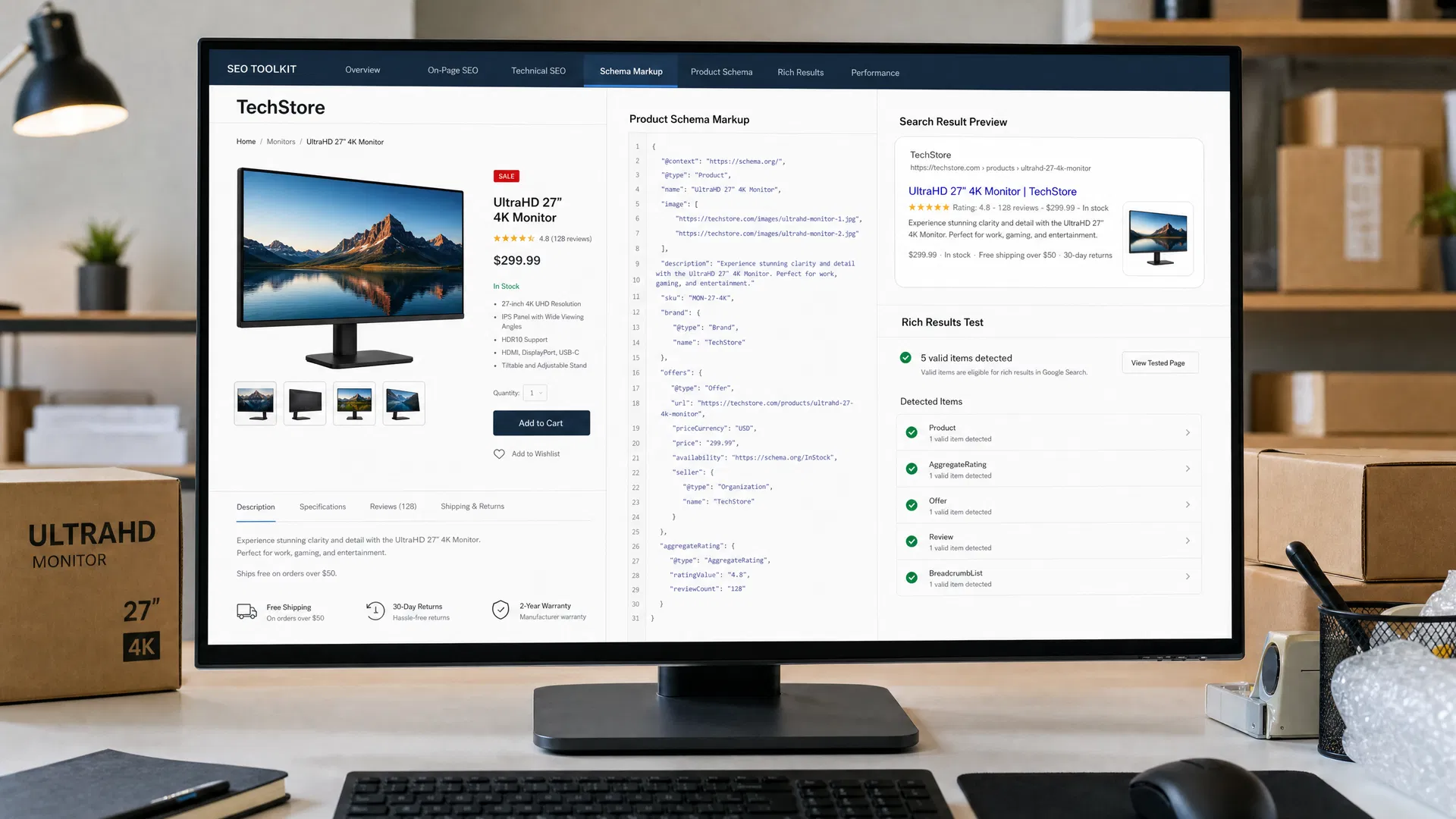
Structured data (Schema.org) is also very useful in e-commerce. The Product type, with its offer (Offer) and, where relevant, its average rating (AggregateRating), allows Google to show rich results: price, availability, reviews. This information can make your result more attractive, but display isn't guaranteed: Google decides whether to show it. Marked-up data must always match the visible content of the page.
| On-Page Element | SEO Best Practice | Mistake to Avoid |
|---|---|---|
| Title tag | Include the main keyword, the brand and a selling point (e.g. 24-hour delivery). Common benchmark: 50 to 60 characters, because Google truncates titles that are too long. | Using the same title on every page or going over the display limit. |
| Meta description | Write persuasive copy with a call to action. Common benchmark: 150 to 160 characters; Google may also rewrite the snippet. | Leaving the tag empty or stuffing it with keywords. |
| Heading tags (H1, H2, H3) | Structure the content logically. One clear H1 per page, with the main keyword: a useful convention, not a Google requirement. | Skipping heading levels (jumping from an H2 to an H4) or using headings purely for design. |
| Images | Compress images, use descriptive file names and fill in the alt attribute. | Uploading multi-megabyte images with generic names (e.g., img_1234.jpg). |
Link Building Strategy for Ecommerce
Link building, meaning earning inbound links (backlinks) to your site, remains an important signal for Google. For an e-commerce site, quality links strengthen domain authority and help strategic pages rank.
Earn quality links to your categories
It's usually hard to earn natural links to product pages, because these pages are purely commercial. The most effective strategy is therefore to focus your link building efforts on your category pages, which have greater traffic potential, or on informational content (blog posts, buying guides) that will then link to your products.
To identify the best link opportunities and monitor your competitors' link profiles, regular Backlink Analysis is essential. Aim for links from relevant sites in your niche that have strong authority and real traffic.
In link building, quality always beats quantity. A single link from an authoritative site in your niche will have far more impact on your SEO than dozens of links from low-quality directories. Favor long-term partnerships and high-value content creation.
Internal linking to distribute link equity
Internal linking is often underused by ecommerce merchants, even though it's a powerful SEO lever that's entirely under your control. It means linking your site's pages together intelligently to make navigation easier for users and pass "link juice" (authority) to the pages you want to push up in the search results.
Here are some effective internal linking techniques for ecommerce:
- Breadcrumbs: Essential for helping users find their way and for reinforcing your site's silo structure.
- Related products: Suggest complementary or similar products on your product pages (cross-selling and upselling).
- Links from the blog: Write informational blog posts and add links to your relevant category and product pages.
- Popular link blocks: Showcase your best sellers or flagship categories on the homepage and in the navigation menu.
Measure and Adjust Your SEO Strategy
SEO is not an exact science, and Google's algorithms change constantly. It's therefore crucial to measure the results of your actions regularly and adjust your strategy based on the data you collect. A "test and learn" approach is the key to long-term success.
The essential KPIs to track
To evaluate the effectiveness of your ecommerce SEO strategy, you need to track the right key performance indicators (KPIs). Don't just look at overall traffic. Analyze the metrics that directly affect your revenue:
- Non-branded organic traffic: This is the traffic generated by queries that don't include your brand name. It's the true indicator of your SEO visibility.
- Organic conversion rate: The percentage of visitors from SEO who make a purchase.
- Revenue generated by SEO: The ultimate metric for calculating the return on investment (ROI) of your efforts.
- Rankings on strategic keywords: Track how your rankings evolve on the queries that generate the most value for your business.
Use custom reports
To save time and make decisions easier, we recommend automating the creation of your dashboards. Generating custom SEO Reports lets you see your site's performance at a glance, spot emerging trends and quickly detect anomalies (a sudden traffic drop, lost rankings, etc.).
By combining data from Google Search Console, Google Analytics and your SEO tools, you'll get a 360-degree view of your online presence. Make sure to run a complete SEO Audit at least once a year to reset your strategy and identify new growth opportunities.
SEO is a marathon, not a sprint. The results of your optimizations can take several weeks, or even several months, to show. Be patient and persistent, and always base your decisions on reliable data rather than gut feeling.
Conclusion: Structure Your E-commerce SEO with Zerkado
Building a high-performing ecommerce SEO strategy takes time, expertise and constant rigor. From technical optimization to content creation, link building and data analysis, there are many complex workstreams. But the payoff in qualified traffic and revenue more than justifies the effort.
To support this work, equip yourself with the right tools. Zerkado is an SEO platform built for agencies and consultants, many of whom work for online stores. It brings together technical audits, rank tracking, content optimization, backlink analysis, internal linking and reporting. For a store, two points matter: the crawl covers up to 200,000 pages depending on the plan, and approved internal links are inserted on WordPress through the Zerkado plugin, or on PrestaShop through the dedicated module.
Explore our features in detail, then check our pricing to choose the subscription that fits your business. A 14-day free trial, with no credit card, lets you test Zerkado on your own store.