
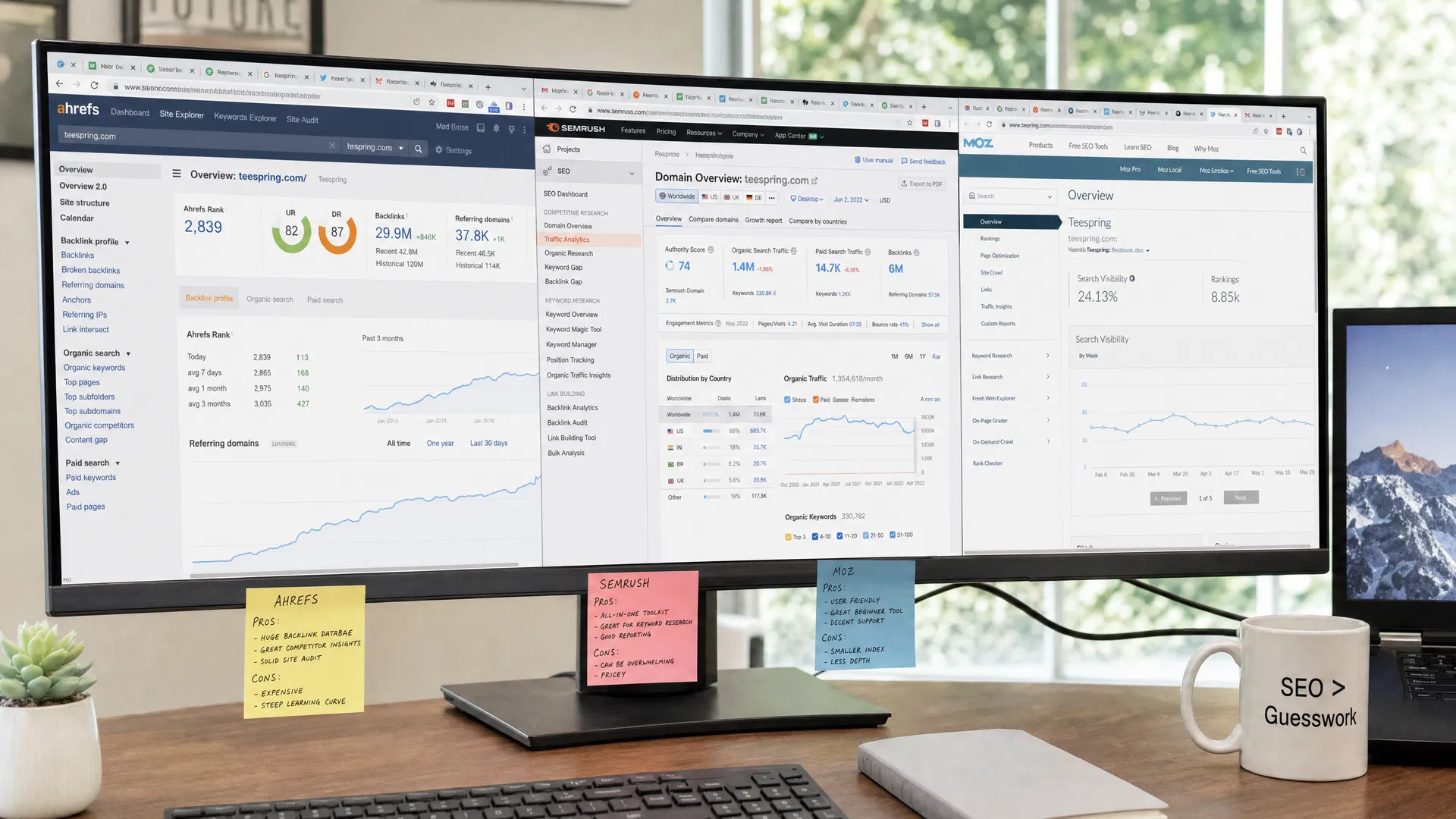
In 2026, almost every SEO tool advertises artificial intelligence. The word alone no longer sets platforms apart. What matters is what the AI actually does, which data it relies on, what it costs, and who reviews what it produces. This guide offers criteria for choosing an AI SEO tool, then looks at where Zerkado and three well-known tools stand.
A word of disclosure: this blog is published by Zerkado, so we are not neutral. We describe Zerkado based on what the product does, and the other tools based on their public websites at the time of writing (October 2026). We quote no competitor prices.
What AI really changes in an SEO tool
Google has long used machine learning to understand queries and pages: RankBrain, unveiled in 2015, is one public example. It also shows generated answers, AI Overviews. In an SEO tool, AI is mainly used for three things:
- Writing and rewriting: titles, meta descriptions, paragraphs, report summaries.
- Sorting and explaining: grouping issues, filtering out false positives, proposing an action plan.
- Watching generative engines: checking whether a site or a brand is cited in AI answers.
In all three cases, the AI suggests and a human decides. A serious tool shows where its suggestions come from and lets you review them before anything changes.
Criteria for choosing an AI SEO tool
- Does the AI work on your data? A suggestion based on your site crawl, your rankings and your Search Console beats a generic text.
- Can you review before applying? Be wary of changes published without approval.
- What does the AI cost? Included credits, paid add-ons, usage per action: read the terms.
- Is the score explained? A useful content score breaks down its factors. A score that promises a citation in AI Overviews promises something no tool can guarantee.
- Does the rest of the tool hold up? AI doesn't replace a reliable crawl, accurate rank tracking and clear reports.
Key takeaway: be wary of promises of a "GEO score" or a guaranteed citation. No tool can reliably predict that a page will be used in a generated answer.
Zerkado: AI applied to agency tasks
Zerkado is an SEO platform for consultants and agencies. Its modules share the project's data (crawl, rankings, Search Console, backlinks), and the AI uses it as context. It steps in at specific points:
- Audit: the SEO audit ranks issues by severity, each with a fix sheet, and the AI proposes an action plan.
- Content: content optimization compares your page with the top-ranking pages on Google. It calculates a score from 0 to 100, broken down into seven factors: semantics, intent, structure, on-page, SERP match, Search Console and internal linking. The AI suggests rewrites with a before/after view, which you review before applying them.
- Cannibalization: an AI filter, run when you decide, checks groups of conflicting pages and filters out false positives, with the reason it retained.
- Reports: the AI writes a summary that you can edit before sending.
- AI Visibility: depending on the plan, this module checks, for the questions you choose, whether conversational engines cite your site.
- Writing: depending on the plan, the AI writing module drafts articles and publishes them to WordPress.
Rank tracking and backlink analysis round out these modules. AI actions use credits, included each month depending on the plan; you can also use your own API keys. The website and the app are available in five languages: French, English, German, Spanish and Italian. Finally, Zerkado does not calculate a GEO score.
Semrush, Ahrefs and SE Ranking: where does their AI stand?
At the time of writing, all three tools offer AI features: writing assistance, suggestions, or tracking of a brand's presence in AI answers, depending on the tool and the plan. Their scope and cost change often: check them on each vendor's website before comparing.
- Semrush is a very broad marketing suite, with extensive keyword and link databases and tools beyond SEO.
- Ahrefs is a benchmark for link analysis, with one of the largest backlink indexes on the market.
- SE Ranking offers a complete SEO platform, with white-label reports depending on the plan or as an add-on.
To compare these tools beyond AI, read our comparison of the best SEO tools for 2026.
Table: the questions to ask, and Zerkado's answers
| Criterion | Question to ask | With Zerkado |
|---|---|---|
| AI on your data | Are the suggestions based on your site? | Yes: the project's crawl, rankings, Search Console and backlinks serve as context |
| Human review | Can you approve before publishing? | Yes: rewrites with a before/after view, internal links approved before insertion |
| Content score | Is the score broken down? | Score from 0 to 100, across seven factors |
| Citations by AI | Does the tool promise a citation? | No: no GEO score; the AI Visibility module reports the citations actually observed |
| Cannibalization | Are conflicts between pages detected? | Yes, with an AI filter for false positives |
| White-label | Are reports in your branding? | Yes, from the Pro plan |
| AI cost | How many actions are included? | Monthly AI credits depending on the plan |
| Languages | Is the interface in your language? | Interface in 5 languages |
| Agency volume | What do 40 projects cost? | Agency plan at €399/month: 40 projects and 10 users |
Why switch tools, and when not to
Switching tools takes time: migrating projects, losing history, training the team. The good reasons are concrete:
- The real cost rises with every user or option you add.
- The team juggles several tools for the same client.
- Client reports require too much manual work.
- Your current tool's AI features don't serve your actual tasks.
On the other hand, hype is not a reason. If your tool covers your use cases at the right price, keep it.
The best AI SEO tool is the one whose AI saves you time on your own tasks, without taking control away from you. Test before you commit: try Zerkado free for 14 days, with no credit card, and check our pricing page for each plan's quotas.